Expanded & Refined Second Edition
THE
SUBCONSCIOUS
SWING
How Golf Skills Become Automatic
Second Edition
Available
Now
On Amazon
How Golf Skills Become Automatic
You know what you're supposed to do. So why doesn't it last? Most golf instruction focuses on what to change. The Subconscious Swing focuses on the missing step: how consciously learned movement becomes increasingly automatic, reliable, and resilient.
Expanded and refined, the Second Edition explains why temporary improvement is often mistaken for learning—and how a clear intention, protected repetition, and enough time allow a developing pattern to take hold.
Define the movement pattern you are trying to learn. A clear, workable intention gives repetition a stable target and prevents every practice session from becoming a search for something new.
Give the developing pattern enough focused repetition to strengthen. Avoid stacking corrections, chasing quick fixes, or replacing the intention before the learning process has had time to run its course.
As the pattern becomes more familiar, conscious control can gradually recede. Practice remains structured; on the course, the golfer uses a simple intention, a consistent routine, and increasing trust.
You just had a great lesson. Your pro explained exactly what you were doing wrong, showed you the fix, and it made perfect sense. You even hit a few good ones before you left.
Then you stepped onto the first tee Saturday morning — and the old swing came back like it never left.
Sound familiar? It's not a lack of effort. It's not poor instruction. It's neuroscience.
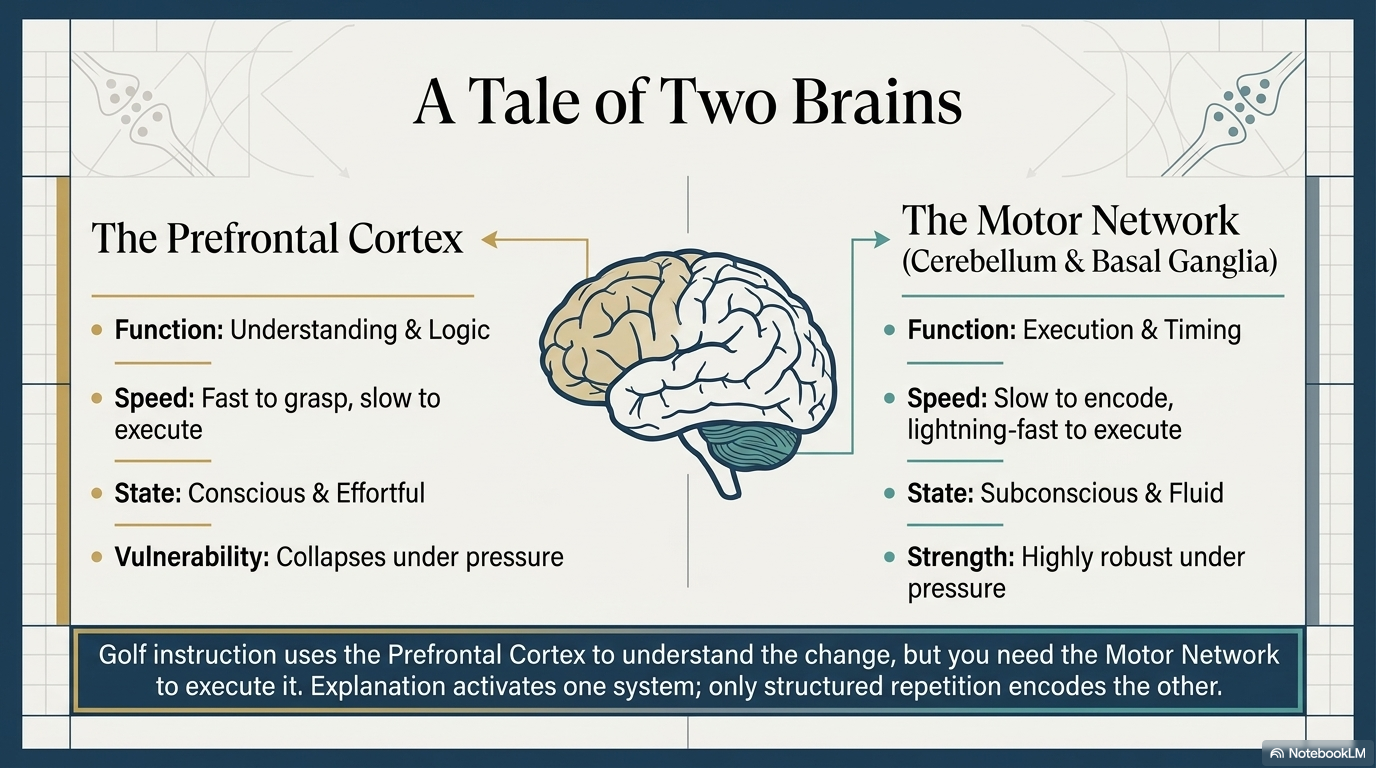
Your brain has two very different systems at work every time you swing a golf club.
The first is the Prefrontal Cortex — the thinking brain. It helps process instruction, understand a correction, and direct attention toward a new movement. When your coach explains the change and it makes perfect sense, conscious understanding has begun—but motor learning is not yet complete.
The second is the broader Motor Network, including the Cerebellum and Basal Ganglia. These systems contribute to timing, coordination, pattern learning, and increasingly automatic execution. They change more gradually through repeated experience.
Explanation can create understanding. Structured repetition builds ownership. Understanding a better swing and being able to reproduce it automatically are two different stages of learning.
A lesson can establish the right direction. You may understand the change completely and even feel it briefly on the range. But the thinking brain receiving the message and the motor system gradually learning the pattern are not the same event.
This is why the swing you understood on Tuesday disappears by Saturday. This is the void The Subconscious Swing was written to fill — not another book about what to change, but a science-backed exploration of how golf skills actually become automatic. Because the goal was never just to understand a better swing.
The goal was always to own one.
Kevin Cotter is a PGA Professional, swing and performance coach, sports psychology certified coach, and author with more than 25 years of experience and over 12,000 lessons taught.
He has worked with golfers ranging from beginners and juniors to collegiate players, top amateurs, mini-tour competitors, and fellow PGA professionals. His coaching connects technical understanding, focused practice, and the mental side of performance.
The Subconscious Swing grew from a recurring lesson-tee problem: golfers often understand the correction, yet the improvement disappears because the learning process was never completed.

Learn why inconsistency may not reflect a lack of ability or effort, but a movement pattern that has not yet received enough focused repetition.
See how competing advice, constant self-diagnosis, and premature changes can interrupt learning just as the new pattern is beginning to strengthen.
Use training sessions to develop the movement. On the course, simplify the intention, commit to the target and routine, and allow the swing to emerge.
The Subconscious Swing — Second Edition is now available in paperback and Kindle on Amazon. Start completing the learning process—and give your improved swing the chance to become your natural swing.
Paperback & Kindle available now on Amazon